

Quasi-Judicial Authorities Cannot Exercise Review Power Without Statutory Backing
"The Supreme Court strikes down a Revenue Officer’s unauthorized review of a land vesting order, holding that executive instructions cannot override statutory limits. Read our latest analysis on why the power of review is not inherent and what it means for administrative law."
Regalius Law Partners3 min read
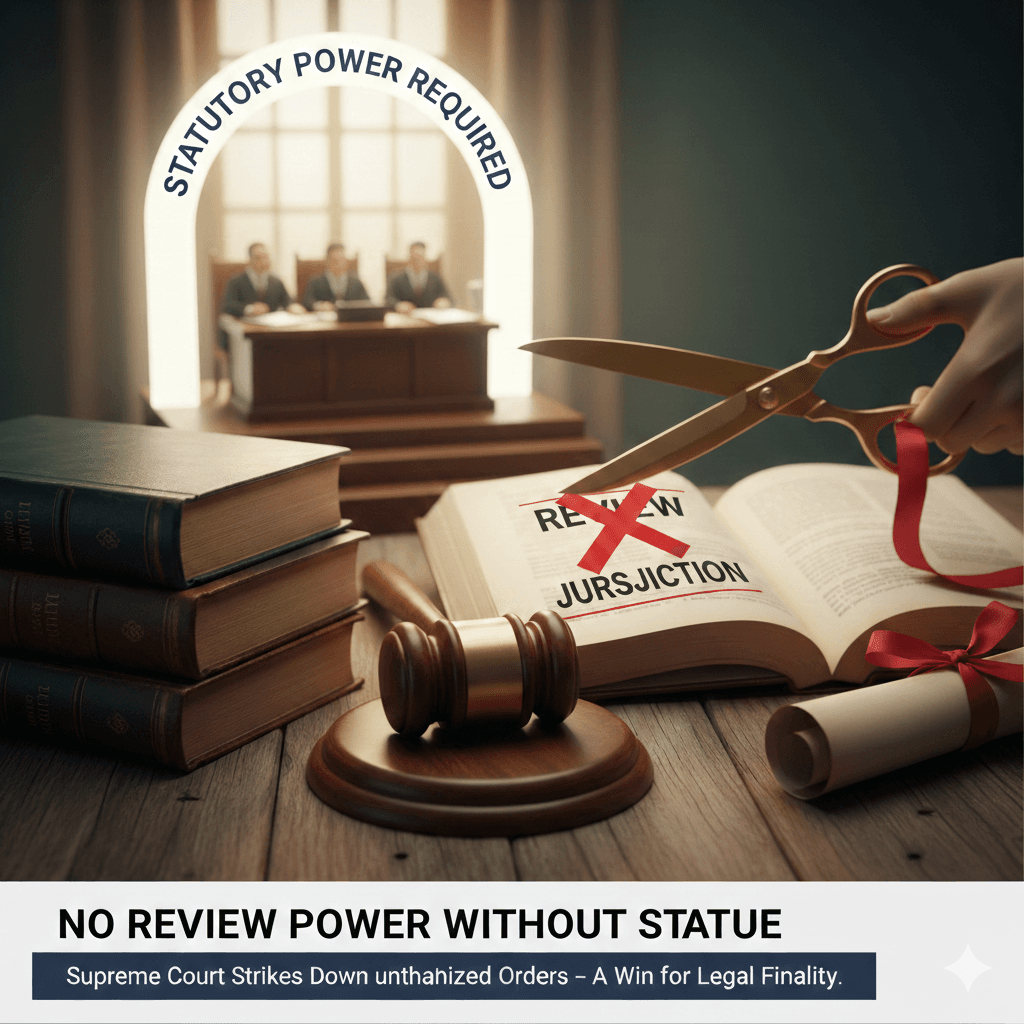
In a significant ruling for administrative and land laws, the Supreme Court of India has reaffirmed that quasi-judicial authorities do not possess an inherent power of review. Unless a specific statute expressly grants this power, any attempt to review a previously settled order is considered void and without legal merit.
The decision, delivered on February 6, 2026, in the case of State of West Bengal v. Jai Hind Pvt. Ltd., serves as a stern reminder that executive instructions cannot override statutory limitations.
The Core Dispute: Executive Interference in Land Vesting
The case originated under the West Bengal Estates Acquisition Act (WBEA), 1953. Initially, a Revenue Officer had passed an order vesting certain disputed lands with the State Government.
Years later, the state's executive wing—specifically the Minister-in-Charge—issued directions to reopen the matter. Citing "economic considerations" and "industrial use," the Revenue Officer reviewed the previous decision and passed a fresh order in favor of the private respondent, Jai Hind Pvt. Ltd.
The Calcutta High Court initially upheld this review, prompting the State to appeal to the Supreme Court.
The Supreme Court’s Verdict
A Bench comprising Justice M.M. Sundresh and Justice N. Kotiswar Singh set aside the High Court's judgment. The Court emphasized several key legal principles:
1. Review is Not an Inherent Power
Unlike procedural powers (like correcting a typo), the power of substantive review is a "creature of statute." If the law (in this case, the WBEA Act) does not expressly grant a Revenue Officer the right to review their own order, they simply cannot do it.
2. Executive Orders Cannot Create Jurisdiction
The High Court had suggested that because the Minister-in-Charge approved the order, the Revenue Officer had the authority to act. The Supreme Court corrected this, stating:
"The High Court incorrectly conflated executive direction with statutory conferment of substantive power."
In short: A Minister’s instruction cannot grant a legal power that the Act itself forbids.
3. Statutory Bar under the WBEA Act
The Court pointed to Section 57B (3) of the Act, which explicitly prohibits Revenue Officers from reopening matters already decided by the State Government or other competent authorities.
Key Takeaways for Litigants and Practitioners
Finality of Orders: Once a quasi-judicial authority (like a Revenue or Income Tax Officer) passes an order, it is final unless a statutory appeal or review process exists.
Jurisdictional Limits: Any order passed through a "review" that isn't authorized by law is void ab initio (legally void from the beginning).
Separation of Powers: Executive policy (like industrial development) cannot be used as a tool to bypass settled judicial or quasi-judicial determinations.
Conclusion
This judgment is a victory for the rule of law over administrative overreach. It ensures that property rights and legal settlements cannot be unsettled by shifting executive priorities or unauthorized reviews by local officials.
Case Title: Tharammel Peethambaran & Anr. v. T. Ushakrishnan & Anr. (Related to secondary evidence) | State of West Bengal vs. Jai Hind Pvt. Ltd. (Context of the Review Jurisdiction ruling).