

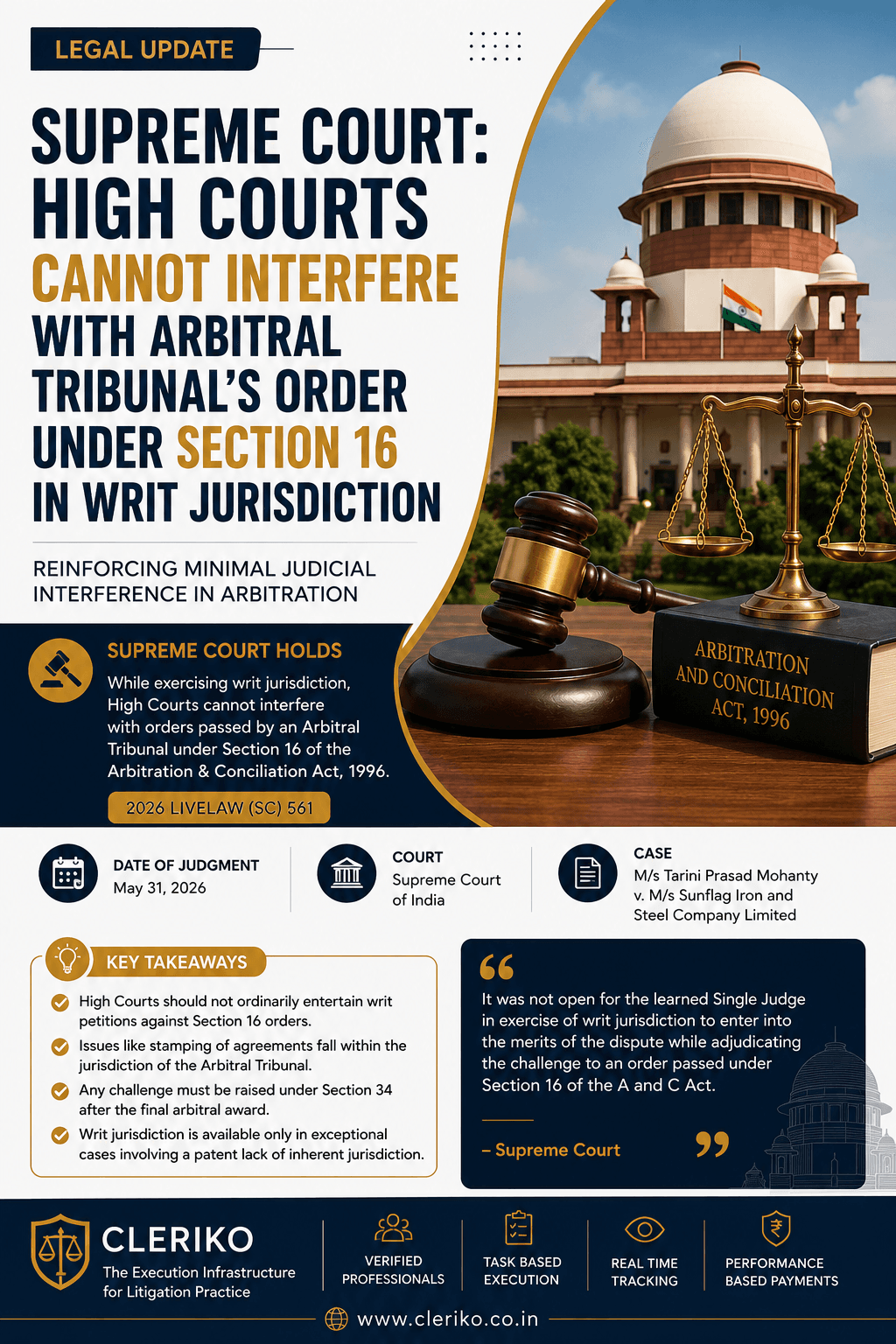
Supreme Court: High Courts Cannot Interfere with Arbitral Tribunal's Section 16 Orders in Writ Jurisdiction
The Supreme Court has reaffirmed the principle of minimal judicial intervention in arbitration by holding that High Courts should not interfere with orders passed by an Arbitral Tribunal under Section 16 of the Arbitration and Conciliation Act, 1996 while exercising writ jurisdiction under Articles 226 and 227 of the Constitution. The Court clarified that such orders can ordinarily be challenged only after the final arbitral award under Section 34 of the Act.
Regalius Law Partners2 min read
Supreme Court Reinforces the Doctrine of Minimal Judicial Interference in Arbitration
In a significant judgment strengthening India's arbitration framework, the Supreme Court has ruled that High Courts cannot interfere with orders passed by an Arbitral Tribunal under Section 16 of the Arbitration and Conciliation Act, 1996, while exercising writ jurisdiction under Articles 226 and 227 of the Constitution, except in rare cases involving a patent lack of inherent jurisdiction.
The ruling came in M/s Tarini Prasad Mohanty v. M/s Sunflag Iron and Steel Company Limited (2026 LiveLaw (SC) 561), where the Court upheld the Orissa High Court Division Bench's decision that had set aside the Single Judge's interference with an arbitral tribunal's order concerning the stamping of an agreement.
The dispute arose when the mine owner challenged the validity of the arbitration proceedings by arguing that the underlying agreement was insufficiently stamped. The Arbitral Tribunal rejected the objection under Section 16 and proceeded with the arbitration. Instead of waiting for the final award, the petitioner invoked the High Court's writ jurisdiction.
The Supreme Court held that the arbitral tribunal was fully competent to decide issues relating to the stamping of agreements, relying upon the Constitution Bench decision in In Re: Interplay Between Arbitration Agreements Under the Arbitration and Conciliation Act, 1996 and the Indian Stamp Act, 1899. The Court observed that merely describing a case as "exceptional" does not justify interference under Articles 226 or 227.
Importantly, the Court reiterated that Section 16(6) expressly provides a statutory remedy. Any party aggrieved by a tribunal's decision on jurisdiction must challenge it under Section 34 after the final arbitral award, rather than seeking premature intervention through writ proceedings.
Key Takeaways
1.High Courts should not ordinarily entertain writ petitions against Section 16 orders.
2.The Arbitration and Conciliation Act promotes minimal judicial interference.
3.Questions relating to the stamping of agreements fall within the jurisdiction of the Arbitral Tribunal.
4.Challenges to Section 16 decisions should generally be raised under Section 34 after the arbitral award.
5.Writ jurisdiction is available only in exceptional cases involving a patent lack of inherent jurisdiction.
6.This judgment further strengthens India's pro-arbitration jurisprudence by reaffirming the autonomy of arbitral tribunals and limiting judicial intervention during ongoing arbitration proceedings.