

SUPREME COURT: A TIME-BARRED PLAINT CAN BE REJECTED AT THE THRESHOLD
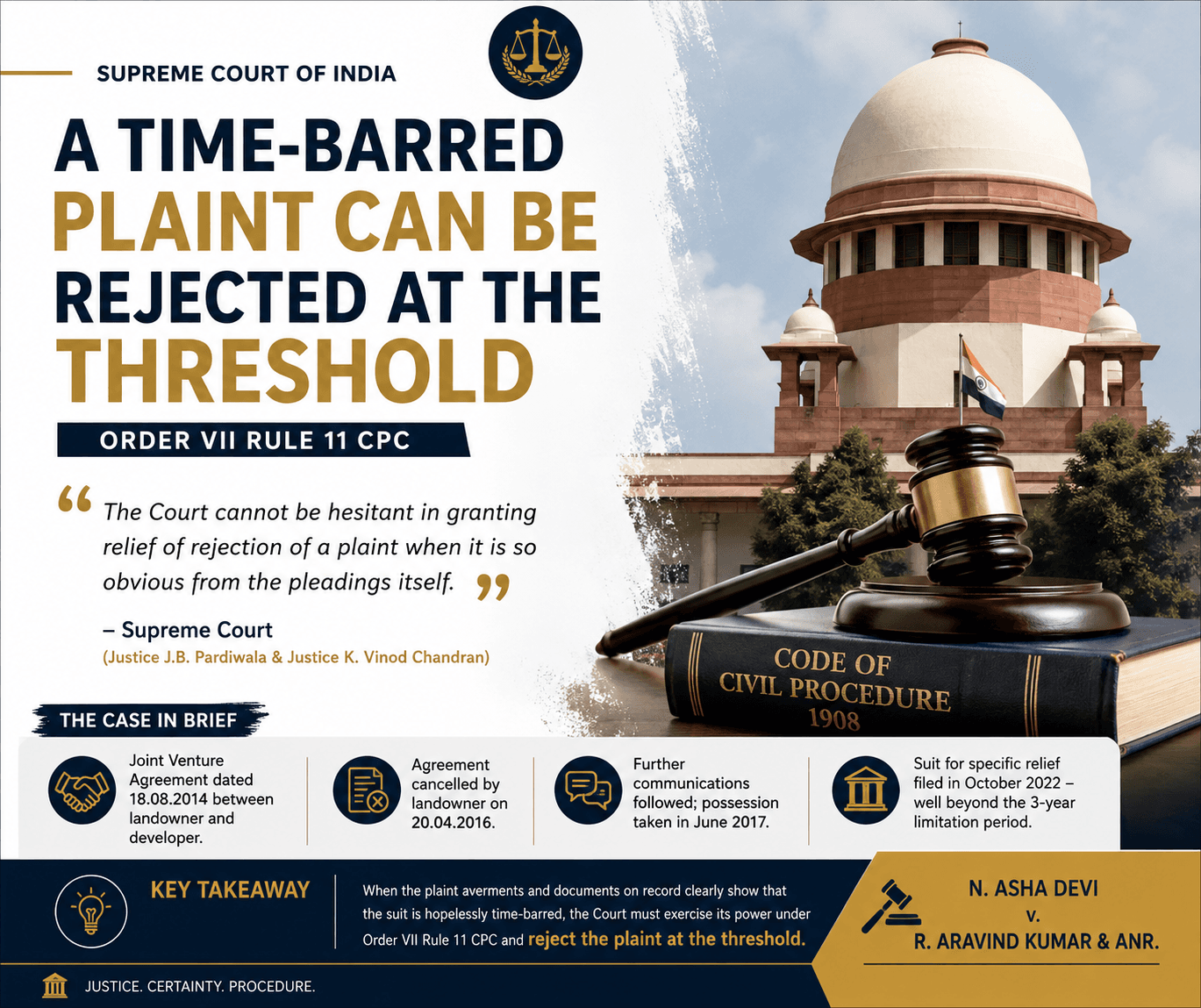
The Supreme Court in N. Asha Devi v. R. Aravind Kumar & Anr. reaffirmed that where the plaint itself clearly reveals that the suit is barred by limitation, the Court can reject it at the threshold under Order VII Rule 11 CPC, without waiting for a full-fledged trial. “The Court cannot be hesitant in granting relief of rejection of a plaint when it is so obvious from the pleadings itself.”
Regalius Law Partners2 min read
Facts of the Case — N. Asha Devi v. R. Aravind Kumar & Anr.
The dispute arose out of two Joint Venture Agreements dated 18 August 2014 between N. Asha Devi, the landowner, and R. Aravind Kumar & Anr., the developer/respondents.
The agreements concerned two vacant plots measuring 4,800 sq. ft., on which the developer was required to construct eight flats.
Under the arrangement, after completion, 56% of the super built-up area was to belong to the landowners, while the developer was entitled to 44% undivided share in the land and the corresponding built-up area.
The landowner alleged that the construction was not completed within the stipulated 15-month period and consequently cancelled the Joint Venture Agreements on 20 April 2016.
A lawyer's notice followed on 22 July 2016, to which the developer replied on 23 July 2016, disputing the unilateral cancellation.
Further communications were exchanged in August, September and November 2016. The landowner ultimately took possession of the properties in June 2017.
Despite these events, the developer filed O.S. No. 632 of 2022 before the Additional District and Sessions Judge, Chengalpattu, seeking division and allotment of its 44% share in the land and built-up area.
The suit was instituted only in October 2022, more than six years after the cancellation of the Joint Venture Agreements.
The landowner therefore filed an application under Order VII Rule 11 CPC, arguing that the suit was barred by limitation.
The Trial Court rejected the application, and the High Court upheld that decision, principally on the reasoning that limitation could involve a mixed question of fact and law requiring trial.
The matter ultimately reached the Supreme Court, which examined the plaint itself and particularly Paragraph 17, where the plaintiff had set out the dates constituting its alleged cause of action. The Court concluded that the cause of action arose when the Joint Venture Agreement was cancelled on 20 April 2016, and that subsequent communications did not create a fresh cause of action.
The suit filed in October 2022 was therefore held to be ex facie time-barred, and the Supreme Court directed rejection of the plaint under Order VII Rule 11 CPC.