

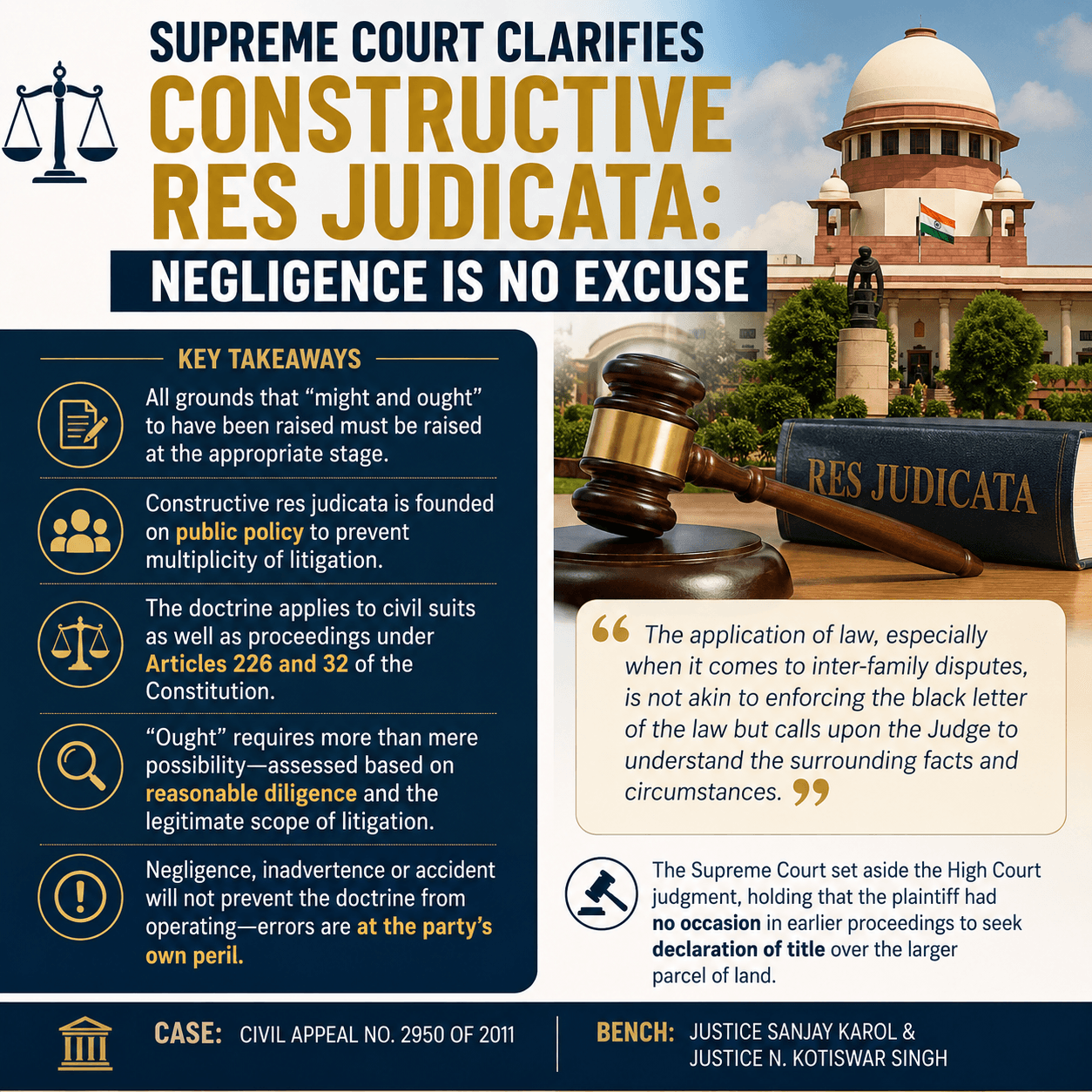
⚖️ Supreme Court Clarifies Constructive Res Judicata: Negligence Is No Excuse
The Supreme Court has reaffirmed that the doctrine of constructive res judicata bars not only issues actually raised in earlier proceedings but also those that could and should have been raised. The Court clarified that omissions caused by negligence, inadvertence, or accident do not exempt a litigant from the doctrine, while emphasizing that its application depends on the facts of each case and the scope of the earlier litigation.
Regalius Law Partners2 min read
In a significant judgment, the Supreme Court has reaffirmed that the doctrine of constructive res judicata bars not only issues that were actually raised in earlier proceedings but also those that could and should have been raised.
The Court emphasized that litigants are expected to exercise reasonable diligence and cannot avoid the consequences of omitted grounds by claiming negligence, inadvertence, or accident.
📌 Key Takeaways from the Judgment:
✅ All grounds that “might and ought” to have been raised must be raised at the appropriate stage.
✅ Constructive res judicata is founded on public policy to prevent multiplicity of litigation and ensure that parties are not vexed twice for the same dispute.
✅ The doctrine applies not only to civil suits but also to proceedings under Articles 226 and 32 of the Constitution.
✅ The word “ought” requires more than mere possibility—it is assessed based on reasonable diligence and the legitimate scope of the litigation.
✅ Failure to raise a ground due to negligence, inadvertence, or accident does not exempt a party from the doctrine's operation.
However, applying these principles to the facts of the case, the Supreme Court set aside the Chhattisgarh High Court's decision, holding that the plaintiff had no occasion in the earlier proceedings to seek a declaration of title over the larger parcel of land. The earlier suits were confined to challenging specific sale transactions.
The Court cautioned against a rigid application of legal principles, particularly in long-standing family property disputes, observing that:
"The application of law, especially when it comes to inter-family disputes, is not akin to enforcing the black letter of the law but calls upon the Judge to understand the surrounding facts and circumstances.
📖 Case: Civil Appeal No. 2950 of 2011
👨⚖️ Bench: Justice Sanjay Karol & Justice N. Kotiswar Singh
#SupremeCourt #ResJudicata #ConstructiveResJudicata #CivilProcedureCode #Litigation #PropertyLaw #LegalUpdate #IndianJudiciary #Lawyers #LegalInsights #CourtJudgment