

Supreme Court Fixes Jurisdiction for Arbitration Extensions
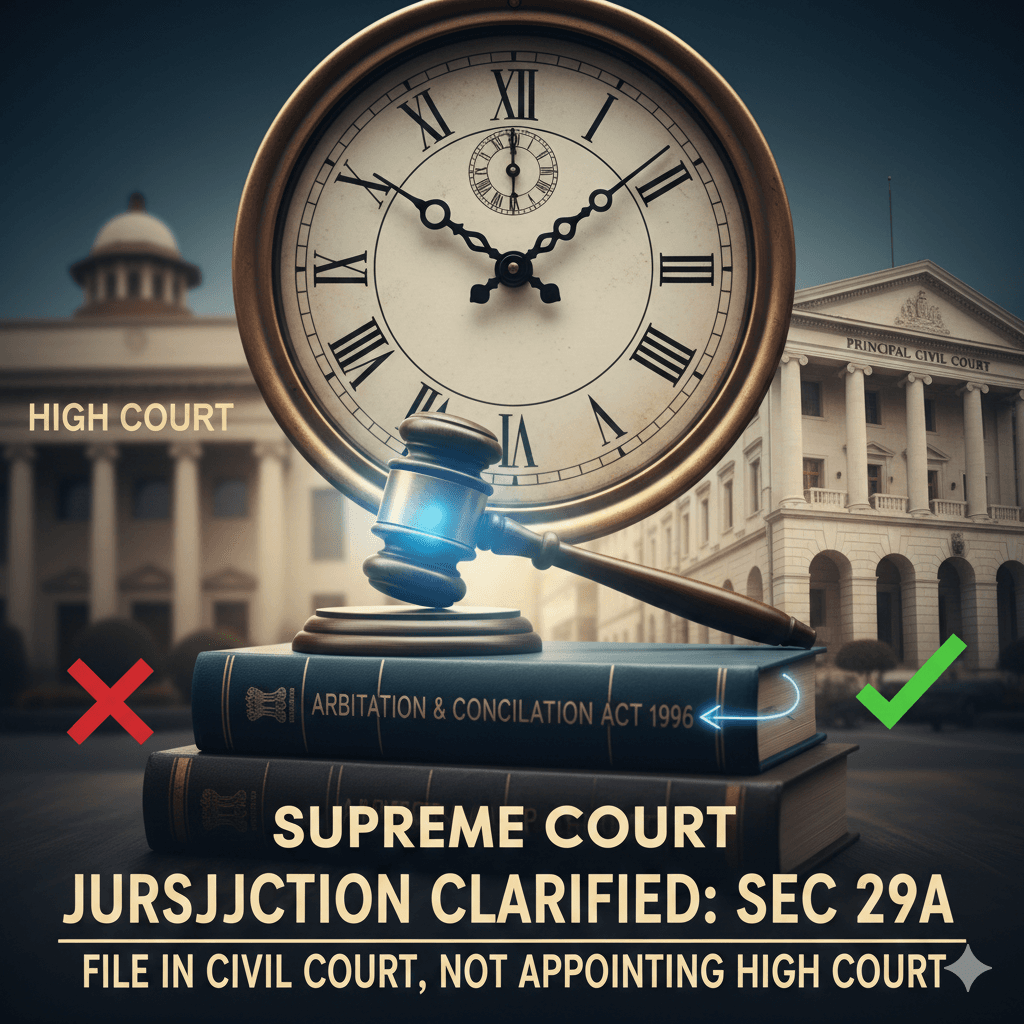
Does the High Court keep a 'Big Brother' watch on arbitration? The Supreme Court says no. In a major procedural clarification, the SC rules that Section 29A extensions for arbitration mandates must be filed in the Principal Civil Court, regardless of which court appointed the arbitrator. Learn why the High Court is now 'functus officio' once the tribunal is formed.
Regalius Law Partners1 min read
In the recent ruling of Jagdeep Chowgule v. Sheela Chowgule & Ors. (2026), the Supreme Court cleared the air on who has the power to extend arbitration deadlines under Section 29A of the Arbitration Act.
The Ruling
The Court held that applications to extend an arbitrator’s mandate must be filed before the Principal Civil Court of original jurisdiction (as defined in Section 2(1)(e)), even if the arbitrator was originally appointed by a High Court or the Supreme Court.
Key Takeaways
No "Big Brother" Supervision: The High Court’s role ends the moment it appoints an arbitrator under Section 11. It does not "watch over" the proceedings or maintain residual control.
Legal Clarity: The "Court" mentioned in Section 29A is the local Civil/Commercial Court, not the superior "Referral Court."
Efficiency: This prevents parties from having to approach High Courts for routine procedural extensions, saving time and legal costs.
Why It Matters
If your arbitration is nearing its 12-month or 18-month deadline, you must file for an extension in the District/Commercial Court—not the High Court that started the process. Filing in the wrong forum could lead to your extension being invalidated.